
Implantology
Replacing a missing root with a titanium implant gives the jaw back a stable support — and the smile its full function.
What is a dental implant?
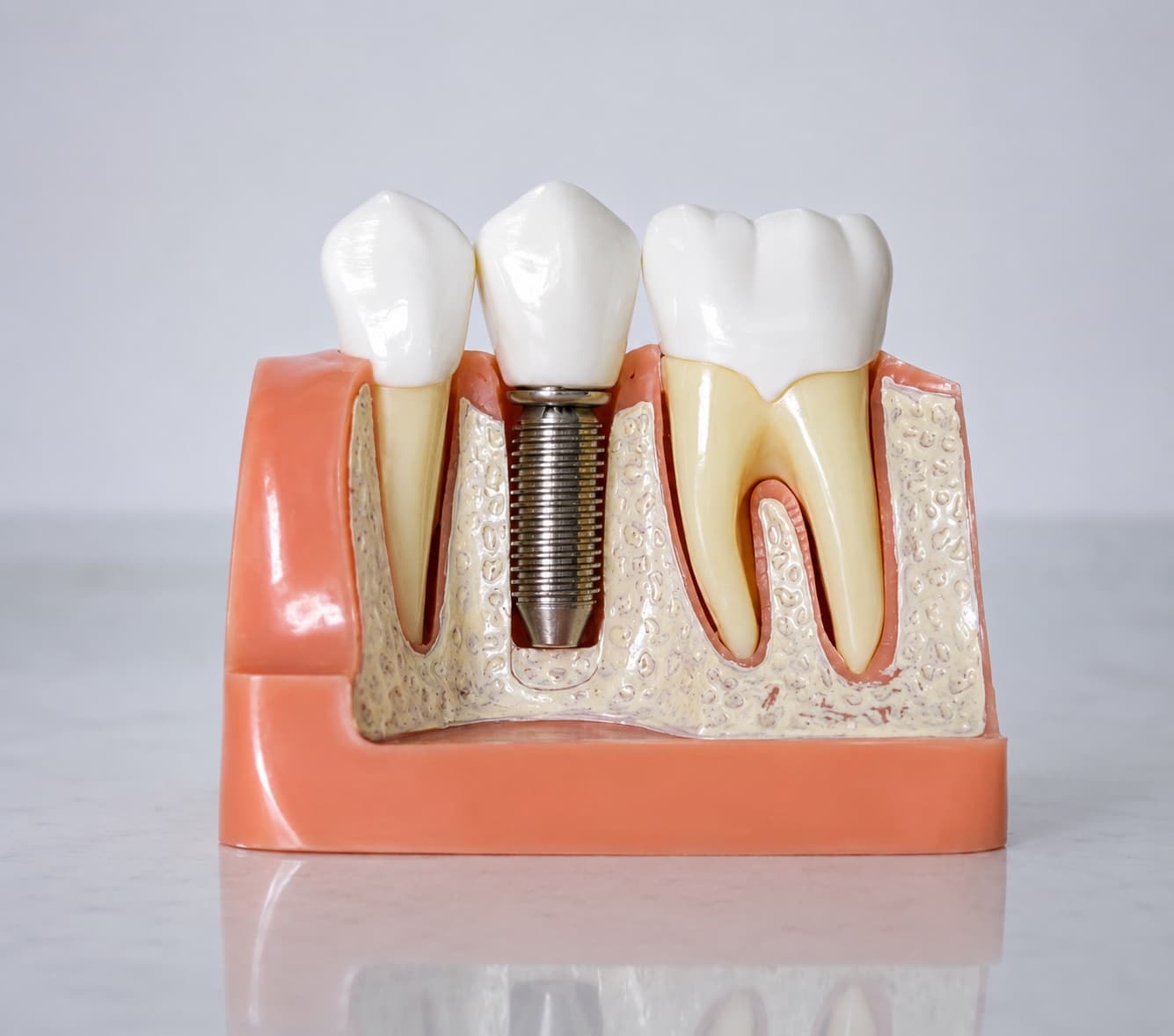
When a tooth can no longer be saved — too damaged, too infected, or having lost its bone support — a dental implant offers a lasting solution: it replaces the natural root with an artificial one, usually titanium, anchored directly in the bone.
- 01
The two stages of treatment
Treatment happens in two stages, usually several months apart, giving the bone time to rebuild around the implant. The practice handles the whole journey, from the surgery to the final crown.
- Implant surgery
- The implant is placed in the bone under local anaesthesia.
- The implant-supported crown
- Once the implant is firmly integrated into the bone — a natural process called osseointegration, lasting two to four months — the final crown is screwed onto it.
- Placed under local anaesthesia
- Osseointegration takes two to four months
- Surgery and prosthetics both done in-house
- 02
Care from start to finish
Before any implant is placed, the gums and bone must be in optimal health — that is the purpose of the periodontal assessment beforehand. Available bone volume is measured with three-dimensional imaging and, where bone height is insufficient — particularly around the upper molars — a technique called a sinus lift builds it up before placement.
- Periodontal assessment before any surgery
- Bone volume measured with 3D imaging
- Sinus lift where bone height is insufficient
- 03
What an implant can solve
Implants answer very different situations, from a single tooth to a full arch.
- Replacing a tooth missing since birth or lost in an accident
- Replacing several teeth, or an entire arch
- Regaining natural chewing and a natural smile, without touching the neighbouring teeth
- 04
Replacing one tooth
A single implant topped with a ceramic crown restores the missing tooth without touching its neighbours. Shade and shape are worked so the restoration goes unnoticed, front teeth included.
- No healthy neighbouring tooth cut down
- Bone preserved through loading
- Cared for exactly like a natural tooth
- 05
Replacing several teeth
When several adjacent teeth are missing, two implants are often enough to carry a three or four unit bridge. The result is fixed, cleans normally and avoids a removable denture.
- Fixed bridge on implants
- Fewer implants than teeth replaced
- Chewing comfort restored
- 06
Replacing all teeth
A full arch can be restored on implants, either with a fixed screw-retained prosthesis or with a removable one stabilised by attachments. The choice depends on bone volume, aesthetic expectations and budget.
- Fixed screw-retained or stabilised prosthesis
- An end to a loose full denture
- Efficient chewing regained
- 07
All-on-4 and All-on-6
These protocols rebuild an entire arch on four or six implants, using the areas where bone is densest. They often avoid a bone graft and allow a fixed temporary prosthesis to be fitted very soon after surgery.
- Full arch on 4 to 6 implants
- Bone grafting often avoided
- Fixed temporary prosthesis fitted quickly
- 08
PRF — platelet-rich fibrin
A small amount of your blood is centrifuged to isolate a concentrate of platelets and growth factors. Applied to the surgical site, this PRF speeds up tissue healing and eases recovery. It is entirely autologous: nothing foreign is introduced.
- Autologous, no additives
- Faster gum healing
- Lighter post-operative course
- 09
Pre-implant surgery
Before an implant can be placed, the ground sometimes needs preparing: atraumatic extraction, clearing an infected site, correcting a ridge that is too thin or a gum that is too scarce. These preparatory steps determine long-term implant stability.
- Atraumatic extractions
- Infected sites cleared
- Soft tissue reshaped
- 10
Computer-guided surgery
The implant is first placed virtually on the 3D scan, on the ideal axis for the future crown. A custom surgical guide then transfers that plan to the mouth, which makes the procedure faster, more accurate and often less invasive.
- Planned position reproduced exactly
- Shorter procedure
- Often flapless
- 11
Guided bone regeneration
When available bone is insufficient, a grafting material is placed and protected by a membrane while the patient's own bone rebuilds. This makes it possible to place an implant where volume was missing, under good conditions of stability.
- Bone volume rebuilt
- Membrane protecting the site
- Implant placed in sufficient bone
- 12
Sinus lift
In the upper jaw the sinus often drops after molars are lost, leaving too little bone for an implant. A sinus lift gently raises its membrane and creates bone volume underneath. Depending on the remaining height it is done through a lateral or a less invasive crestal approach.
- Crestal or lateral approach
- Bone volume created under the sinus
- Implants made possible in the molar area
An implant assessment to see clearly
Imaging, bone volume assessment, options and a detailed quote — all laid out before any decision.